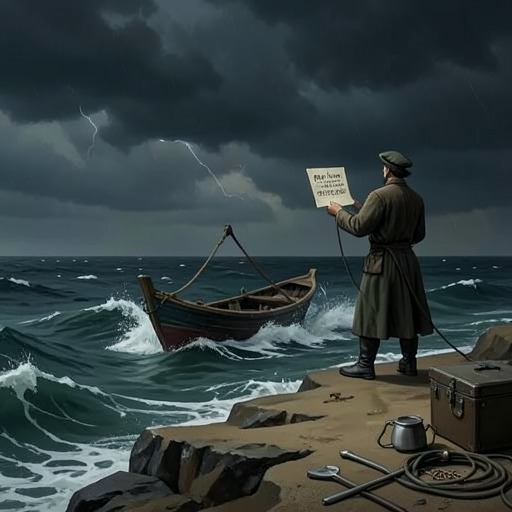
Gernardus Geestemunde
The Man Who LaughsGernardus Geestemunde is the doctor aboard a doomed vessel whose final moments turn on confession, shared responsibility, and a document entrusted to the sea. Initially overlooked by the other passengers, he takes the decisive role when their last practical expedient has failed: he identifies the crime they must acknowledge, reads a parchment aloud, and signs it before the company. His composure does not save the passengers, but his actions leave a material trace of their last testimony in the tarred flask that floats away after the wreck disappears.
Identity and Position
The narrative identifies Geestemunde by his professional title and full name, but supplies no account of his earlier life, his medical practice, or how he came to be aboard. In the crisis at sea, he is one of a group of doomed men rather than an outside rescuer. The others have been trying to find something else to throw overboard, an indication that their available means of escape have been exhausted. Geestemunde has been forgotten in the immediate confusion; his emergence from the companion makes his intervention a late, deliberate answer to a practical question that can no longer be answered practically.
The object he handles is not medical equipment but a pocket-book and a parchment, accompanied by a pen and inkhorn. The scene therefore presents him less as a physician treating individual bodies than as the person able to make the passengers’ shared admission legible. His title distinguishes him, but the responsibility he assumes is communal: the crime he names belongs to the company, and the others respond together.
Confession and the Parchment
Asked what remains to be sacrificed, Geestemunde answers that it is their crime. The passengers shudder and answer together in assent. His brief intervention changes the meaning of the group’s last effort. Their remaining task is no longer to find another object to discard, but to acknowledge what they have done. The narrative does not provide the particulars of that crime in this moment; Geestemunde’s answer establishes its shared moral weight without turning the scene into a detailed explanation.
He then puts away his pocket-book, sets the writing implements on the companion, unfolds the parchment, and begins to read. The reading takes place on the failing surface of the wreck while the sea continues to rise around the company. The document is written in English, and Geestemunde pauses to repeat passages in French, Spanish, Basque, or Italian when the listeners appear to need an explanation. This detail makes his role one of transmission as well as testimony: he ensures that the men around him can understand what is being read, despite their different languages and the pressure of the sinking vessel.
The company listens in silence marked by sobs and gestures of grief. Once the reading is finished, Geestemunde places the parchment flat, takes up his pen, and signs the clear space he has left at the bottom. He gives his name and title, then calls the others to sign as well. The act makes his own participation explicit while inviting the rest of the group to attach their names to the same record. The passage does not state what each passenger does in response to that invitation, so the significance lies in the offered act of collective attestation, not in an unreported set of signatures.
The Final Minutes
After the reading and signature, Geestemunde tells the others that they are going to die. He takes the torch from Ave Maria and waves it; a spark breaks away into the night. The gesture is brief and cannot reverse the vessel’s decline. It instead accompanies the passage from the attempted work of survival to the passengers’ final acceptance of their condition.
When Geestemunde looks down, the others’ heads are already beneath the water. He takes the flask he had placed on the companion and raises it above his head. As the wreck sinks, he continues the prayer. The narration follows his disappearance in stages: first his shoulders, then his head, and finally the arm holding the flask. This measured sequence makes the object the last visible continuation of his action, while withholding any suggestion that he himself escapes.
Narrative Role and Significance
The only thing reported to remain afloat is the tarred flask, kept up by its osier covering. The snow continues to fall as the waves carry it into darkness. Geestemunde’s final effort therefore leaves no surviving speaker in the scene, but it does leave a vessel containing the written record. The contrast is central to his narrative function: the passengers vanish, while the document’s container passes beyond the wreck and preserves the possibility of later discovery.
Geestemunde is characterized through this compact sequence of choices rather than through biography or extended dialogue. He moves from being forgotten to becoming the group’s reader and signatory; he names the crime, makes the parchment comprehensible to listeners of several languages, and continues the prayer while sinking. The episode gives him neither a rescue nor an individual explanation of his past. Instead, it makes his significance depend on what he does at the threshold of death: he turns an exhausted attempt at physical survival into a final act of acknowledgment, and the flask carries that act onward after he is gone.